Minerals & Industrial
Persian Travertine & Marble Supplier: Direct Iranian Sourcing and Bitumen 60/70 Bulk Export
Direct Iranian sourcing of travertine and marble slabs for export, plus Iranian bitumen 60/70 bulk export for road construction. Quarry-direct pricing, block and slab specifications, packaging and documentation.
- Origin
- Azerbaijan & Isfahan, Iran
- Minimum order
- 1 container
- Primary market
- Global Construction
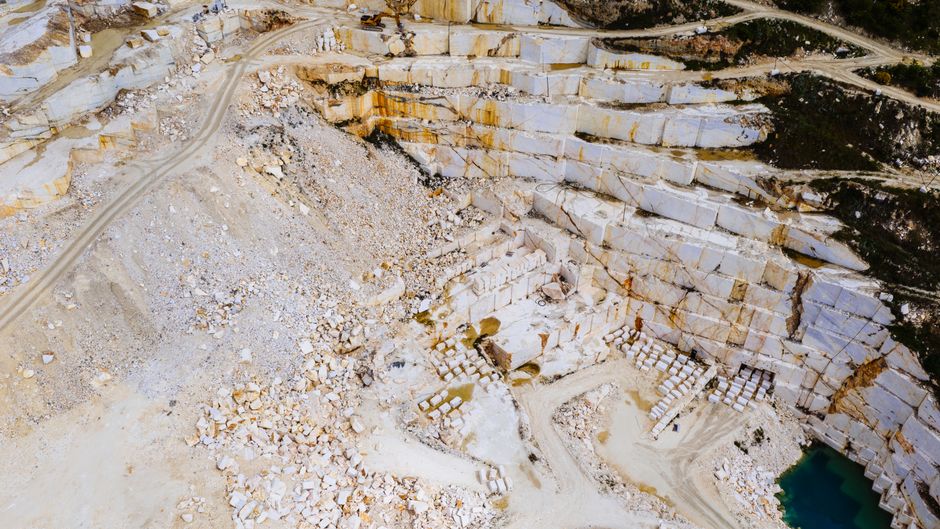
Iran sits on one of the world’s largest natural stone reserves and produces travertine, marble, granite and onyx from quarries spread across the country — most prominently in West Azerbaijan (travertine), Isfahan (marble), and Fars (marble and travertine). The same geology that made Iran a stone exporter also made it a hydrocarbon producer, which is why this page covers both stone and bitumen: they are the two industrial-mineral export categories that international construction buyers most often source together, and they share logistics, packaging and documentation conventions. Whether you are sourcing Direct Iranian Sourcing Export Travertine Marble for a façade project, a Persian Marble Slabs Supplier for a tile line, or Iranian Bitumen 60/70 Bulk Export for an asphalt programme, the framework below is how Palude structures the engagement.
Direct Iranian Sourcing Export Travertine Marble: the quarry-direct case
The case for Direct Iranian Sourcing Export Travertine Marble is the same case that drives every direct-sourcing decision: the elimination of a trading-house margin between the quarry and the end user. Iranian stone passes through several layers of traders between the quarry face and a destination-market project — a local quarry agent, a stone-market wholesaler in Tehran or Isfahan, an export trading house, and often a destination-market stone importer. Each layer adds 8-20% to the price. A direct sourcing relationship with Palude removes the export trading-house layer and, for buyers whose volume justifies it, the wholesale-market layer as well.
The trade-off is the same trade-off direct sourcing always carries: the buyer assumes responsibility for quality verification that the trading house would otherwise perform. We replace that function with on-site quarry inspection, block-by-block selection at the cutting factory, and photographic documentation of every slab before it ships. A buyer who wants the direct-sourcing price without the verification work is a buyer who eventually receives a container of slabs with veins or fillers that do not match the approved sample.
Persian Marble Slabs Supplier: the specification that matters
A Persian Marble Slabs Supplier engagement starts with the specification, not the colour name. Iranian marble is sold under trade names (Persian Silk, Harsin, Dehbid, Sefid Pietra) that describe a colour and a quarry but do not, on their own, define a usable slab spec. The specification a buyer needs to issue includes:
- Block or slab: blocks are the raw sawn stone from the quarry (cheaper per cubic metre, but the buyer assumes the cutting yield risk); slabs are pre-cut at the Iranian factory (higher per-square-metre cost, but the buyer sees exactly what is shipping).
- Thickness: 2 cm and 3 cm are the standard slab thicknesses; 1.5 cm and 1.8 cm are available for tile and cladding lines.
- Dimensions: slab sizes run typically 270-320 cm long by 160-195 cm wide; oversized slabs up to 340 x 200 cm are available from some quarries at a premium.
- Finish: polished (the default for interior), honed (matte, for floors and high-traffic), brushed, leather, or flamed (for exterior and anti-slip).
- Selection: “first choice” (consistent vein and colour, minimal filler), “second choice” (more variation, more filler, lower price). This is the line item that determines whether a luxury project’s slabs match the approved render.
- Resin and mesh backing: applied to reinforce fragile slabs during transit; required for some marble types, optional for others.
We issue a spec sheet with each of these fields completed, attach a photograph of the actual slab(s) being shipped, and ship against the buyer’s written acceptance of that spec sheet. The most common dispute in stone export is a buyer who approved a sample and received a container whose slabs are a different selection — the spec-and-photo protocol is how we prevent that.
Travertine: the Iranian export where selection dominates
Iranian travertine — particularly the silver, white and beige varieties from the Azerbaijan quarries — is one of the country’s most-exported stones because it is used in volume for façades, flooring and exterior cladding in markets that value the material’s thermal and acoustic performance. Travertine has natural voids that are filled at the factory (filled travertine) or left open (unfilled, for a more rustic finish). The selection grade — how many voids, how consistent the fill, how uniform the colour — is the dominant price driver, more so than the quarry name.
For travertine volume buyers we ship a sample set covering the selection range (first, second, commercial) and quote each grade separately so the buyer can choose the selection that matches the project budget. A façade project typically specifies first or second selection; a commercial floor often accepts commercial selection to control cost.
Iranian Bitumen 60/70 Bulk Export: the road-construction grade
Iranian Bitumen 60/70 Bulk Export is the second industrial vertical on this page, and it serves a different buyer: road construction contractors, asphalt plants, and government infrastructure programmes. The “60/70” designation refers to the penetration grade — a needle penetrates the bitumen to a depth of 60 to 70 tenths of a millimetre under standard test conditions — which places it as a medium-grade paving bitumen suitable for most asphalt concrete and road base applications in temperate and hot climates.
Iranian bitumen is produced from Iranian heavy crude at refineries in Tehran, Isfahan, Tabriz and Bandar Abbas, and it is one of the most cost-competitive penetration-grade bitumens in the global export market. The export grades are typically:
- 60/70 penetration — the general-purpose paving grade, the most-exported.
- 80/100 penetration — softer, for cold-climate paving.
- 85/100, 40/50 — specialty grades.
- Cutback bitumen (MC-70, RC-70) and bitumen emulsion (SS-1, CSS-1) — for prime coating, tack coating and cold-mix applications.
Bitumen packaging: drum, bulk and jumbo bag
Iranian bitumen is exported in three packaging formats, each suited to a different buyer:
- New steel drums (180-200 kg net): the default for buyers without heated storage. 80 drums per 20ft container, ~14-16 metric tons per container. Drums are heated and decanted at the destination asphalt plant.
- Jumbo bags (1,000 kg): lower packaging cost per ton than drums, faster decanting, but requires a heated hopper and lifting frame at destination.
- Bulk (Iso-tank or heated reefer tank): the lowest per-ton logistics cost for buyers with heated tank storage; ~24-25 metric tons per Iso-tank.
The packaging choice is a destination-infrastructure decision. A contractor with drum-decanting capability and no heated tank should buy drums; a state-level asphalt programme with heated tank storage should buy bulk.
Bitumen quality and the specification sheet
Bitumen is a commodity, but it is not an undifferentiated commodity. The specification we ship with every bitumen export includes:
- Penetration (60-70, tested per ASTM D5)
- Softening point (49-56°C, ASTM D36)
- Ductility at 25°C (100 cm minimum, ASTM D113)
- Viscosity at 135°C (ASTM D4402)
- Flash point (230°C minimum, ASTM D92)
- Loss on heating (max 0.2%, ASTM D6)
- Specific gravity at 25°C (1.01-1.05, ASTM D70)
A refinery test certificate for each lot is attached to the proforma and travels with the shipment. Buyers who skip the spec verification sometimes receive bitumen that has been cut with cheaper cutback oils — a substitution that passes a visual inspection and fails a viscosity test at the asphalt plant.
Packaging, MOQ and lead time
- Stone: minimum order one 20ft container (~20-27 tons of slabs, depending on thickness); lead time 18-30 days from slab selection to container loading.
- Bitumen drums: minimum one 20ft container (~14-16 tons); lead time 10-18 days from proforma.
- Bitumen bulk: minimum one Iso-tank (~24-25 tons); lead time 12-20 days depending on refinery scheduling.
Documentation set
Stone export: certificate of origin, packing list, commercial invoice, bill of lading, and block/slab spec sheets with photographs. Bitumen export: refinery test certificate, certificate of origin, packing list, commercial invoice, bill of lading, and MSDS. For both verticals the documentation workflow is covered in our Iran export documentation checklist for international buyers.
Buyers consolidating industrial exports — for example, stone for a project façade alongside Iranian polyethylene film grade supplier volumes for a related construction programme — should plan the consolidation at the proforma stage, as stone and petrochemicals clear customs on different lines.
Starting an industrial-minerals sourcing engagement
For stone, the first step is a written spec: stone type, finish, selection grade, thickness, slab or block, volume, and destination port. For bitumen, the first step is the grade, packaging format, volume, and destination. We respond within one business day with quarry-direct or refinery-direct pricing and a draft proforma. To begin, request a sourcing quote and an industrial-minerals advisor will pick up the file.
Request a quote for this vertical
Share your grade, volume, destination port and certification requirements. A sourcing advisor responds within one business day.
Request a sourcing quote